

Pride points
Best College for Future Leaders
Top 4 in Michigan and top 125 in U.S.
Ranked No. 1 in the MAC
Nine Mid-American Conference championships and six NCAA postseason appearances
Top 100
in the nation for graduate programs in occupational therapy and social work
Research 2 University
1 of 139 institutions designated with high research spending and doctorate production
First Michigan institution
to join the Campus Community Network for viewpoint diversity, open inquiry and constructive disagreement
Rare Accreditation
for top police agencies in Michigan
Bronco basics


265+ academic programs

80+ study abroad programs in 30 countries
33% of students
identify as historically underrepresented or international
0.3% American Indian or Alaska Native | 2.7% Asian | 7.3% Black or African American | 8.6% Hispanic/Latinx | 9.4% International | 4.5% Multiracial | 0.04% Native Hawaiian or Other Pacific Islander | 5.3% Unknown | 61.8% White
150+ majors for undergraduate students
Top 10 undergraduate majors
Aviation flight science | Psychology | Nursing | Aviation management and operations | Finance | Elementary Education | Biomedical sciences | Accountancy | Mechanical engineering | Marketing
Broncos mean business
Top 6% in the world
of business schools accredited at both the undergraduate and graduate levels
World champions
two consecutive years for digital marketing
Top 3 global finish
for five business students at the collegiate DECA conference competition

First and only university
to win the Impact Award for Education Support and Learning Advancement for second consecutive year
Top program
for sales and business marketing for 19th year

9 of 10 Broncos are employed quickly, working in their field in jobs they like

Through WMU's 2024-25 Post-graduation Activity Survey of graduates (bachelor's, master's, doctoral and post-baccalaureate certificate), the University collected data for a total of 3,124 graduates, or 78%, of those who earned their degrees between August 2024 and June 2025. Three weeks before each graduation, all graduating students receive an email on behalf of their college dean, department chairperson or program director with a personalized link to the Post-graduation Activity Survey. Nonrespondents receive at least four reminders via email. The data collection cycle ended on Oct. 31, 2025. Based on the survey respondents, 2,240 were employed full time, 67 were employed part time, 603 employed their degree to gain admittance to graduate school or were otherwise continuing their education, 18 were engaged in military service and 4 were volunteering full time. In addition, 872 of those working full time were satisfied with their job, based on 922 responses, and 1,645 of those working full time had a job related to their degree, based on 1,742 responses. Please review the Career Outcomes Report for detailed information about the methodology.
94% of graduates are working or continuing their education

Through WMU's 2024-25 Post-graduation Activity Survey of graduates (bachelor's, master's, doctoral and post-baccalaureate certificate), the University collected data for a total of 3,124 graduates, or 78%, of those who earned their degrees between August 2024 and June 2025. The data collection cycle ended on Oct. 31, 2025. Based on the survey respondents, 2,240 were employed full time, 67 were employed part time, 603 employed their degree to gain admittance to graduate school or were otherwise continuing their education, 18 were engaged in military service and 4 were volunteering full time. Please review the Career Outcomes Report for detailed information about the methodology.
95% of graduates working full time are satisfied with their job
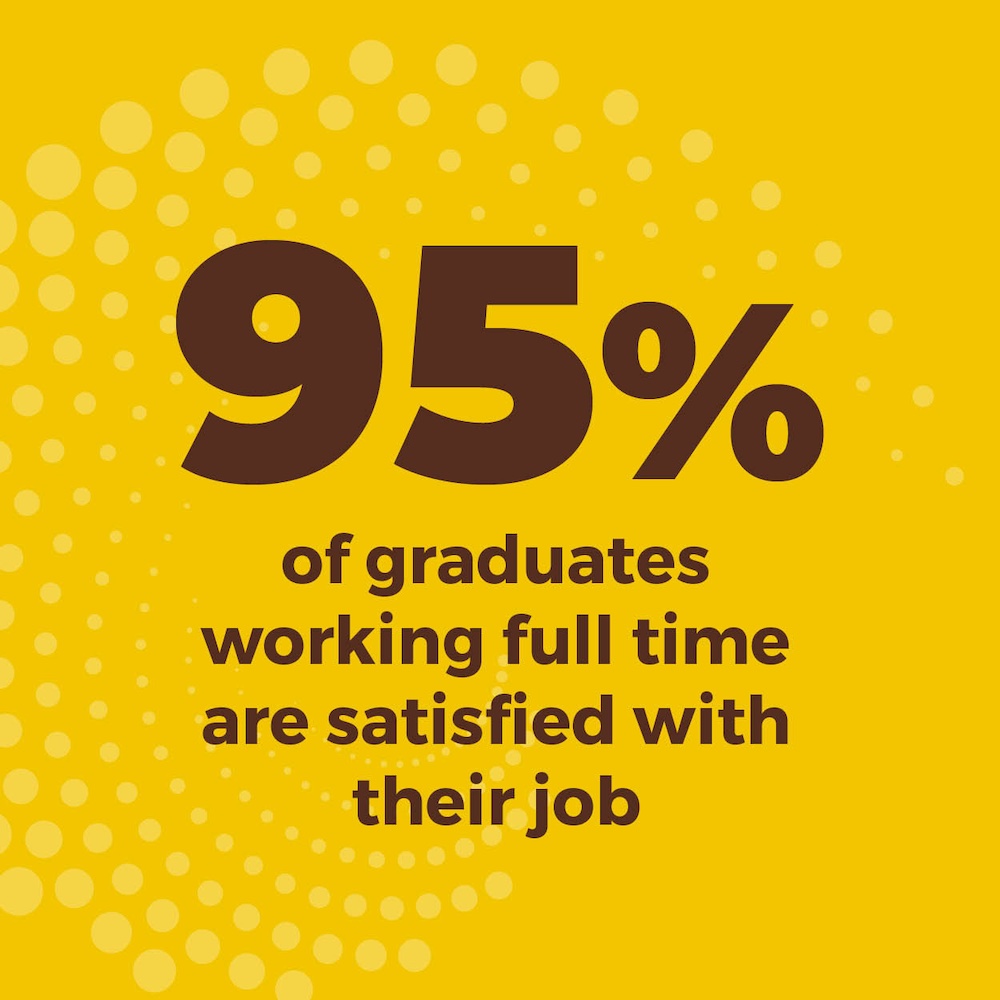
Through WMU's 2024-25 Post-graduation Activity Survey of graduates (bachelor's, master's, doctoral and post-baccalaureate certificate), the University collected data for a total of 3,124 graduates, or 78%, of those who earned their degrees between August 2024 and June 2025. The data collection cycle ended on Oct. 31, 2025. Based on 922 responses from graduates working full time, a total of 872 graduates responded "yes" to the question: "Are you satisfied with your job?" Please review the Career Outcomes Report for detailed information about the methodology.
94% of graduates working full time have a job related to their degree
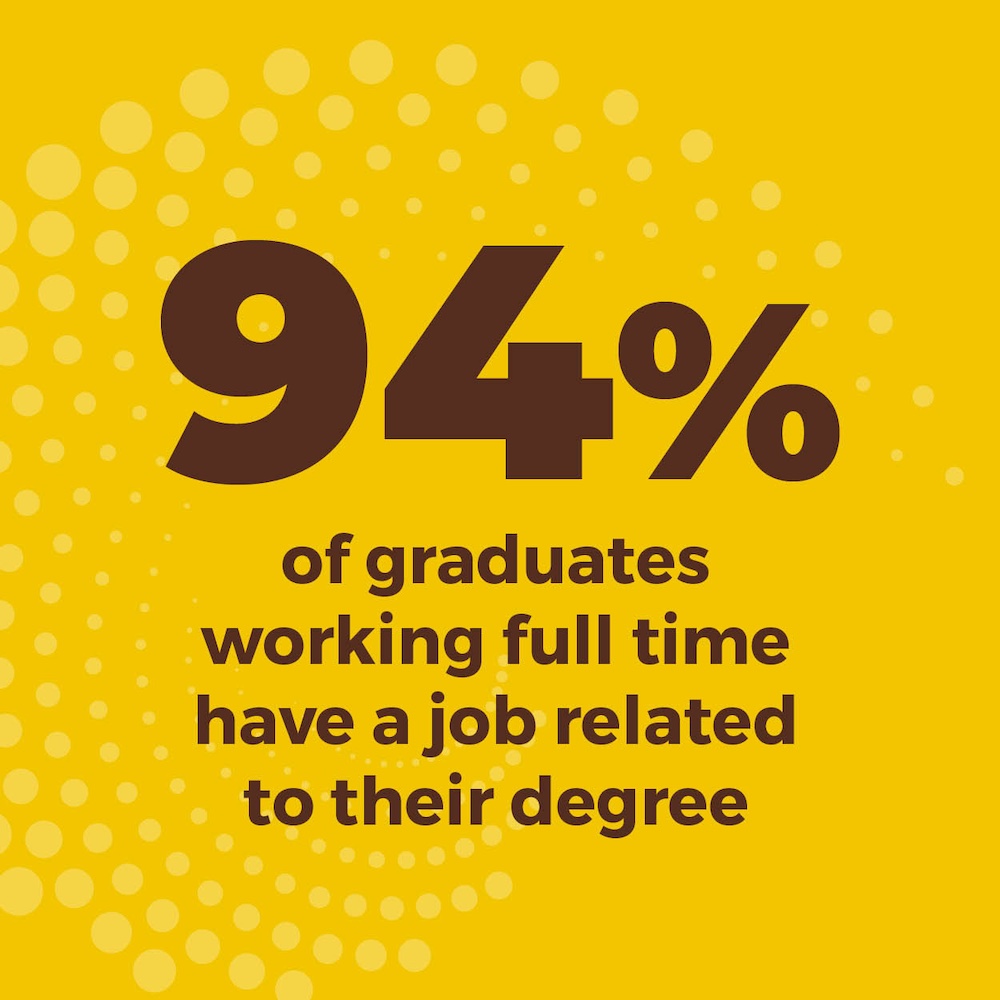
Through WMU's 2024-25 Post-graduation Activity Survey of graduates (bachelor's, master's, doctoral and post-baccalaureate certificate), the University collected data for a total of 3,124 graduates, or 78%, of those who earned their degrees between August 2024 and June 2025. The data collection cycle ended on Oct. 31, 2025. Based on 1,742 responses from graduates working full time, a total of 1,645 graduates responded "yes" to the question: "Is your job related to your degree?" Please review the Career Outcomes Report for detailed information about the methodology.
93% of graduates participated in experience-driven learning
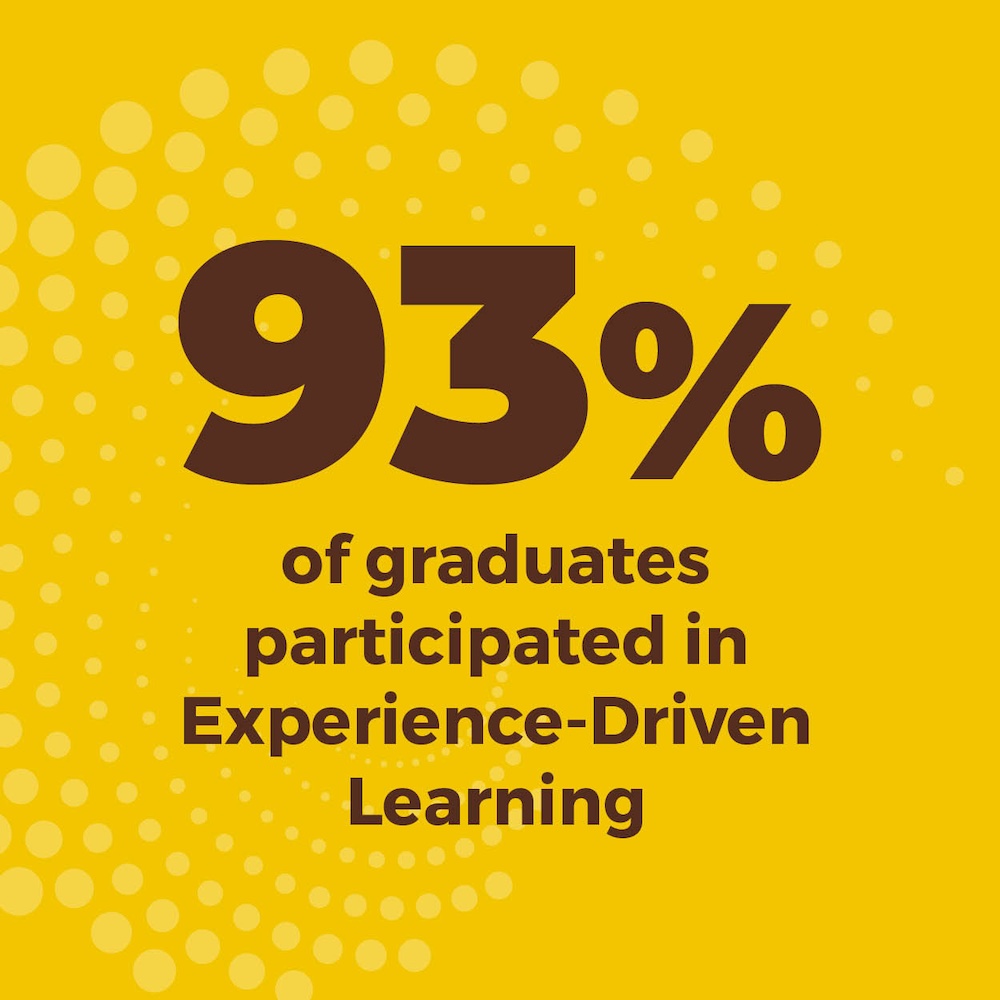
Through WMU's 2024-25 Post-graduation Activity Survey of graduates (bachelor's, master's, doctoral and post-baccalaureate certificate), the University collected data for a total of 3,124 graduates, or 78%, of those who earned their degrees between August 2024 and June 2025. The data collection cycle ended on Oct. 31, 2025. A total of 1,731 graduates reported having participated in experiential learning, based on 1,855 responses. Please review the Career Outcomes Report for detailed information about the methodology.
73% of graduates working full time are employed in Michigan
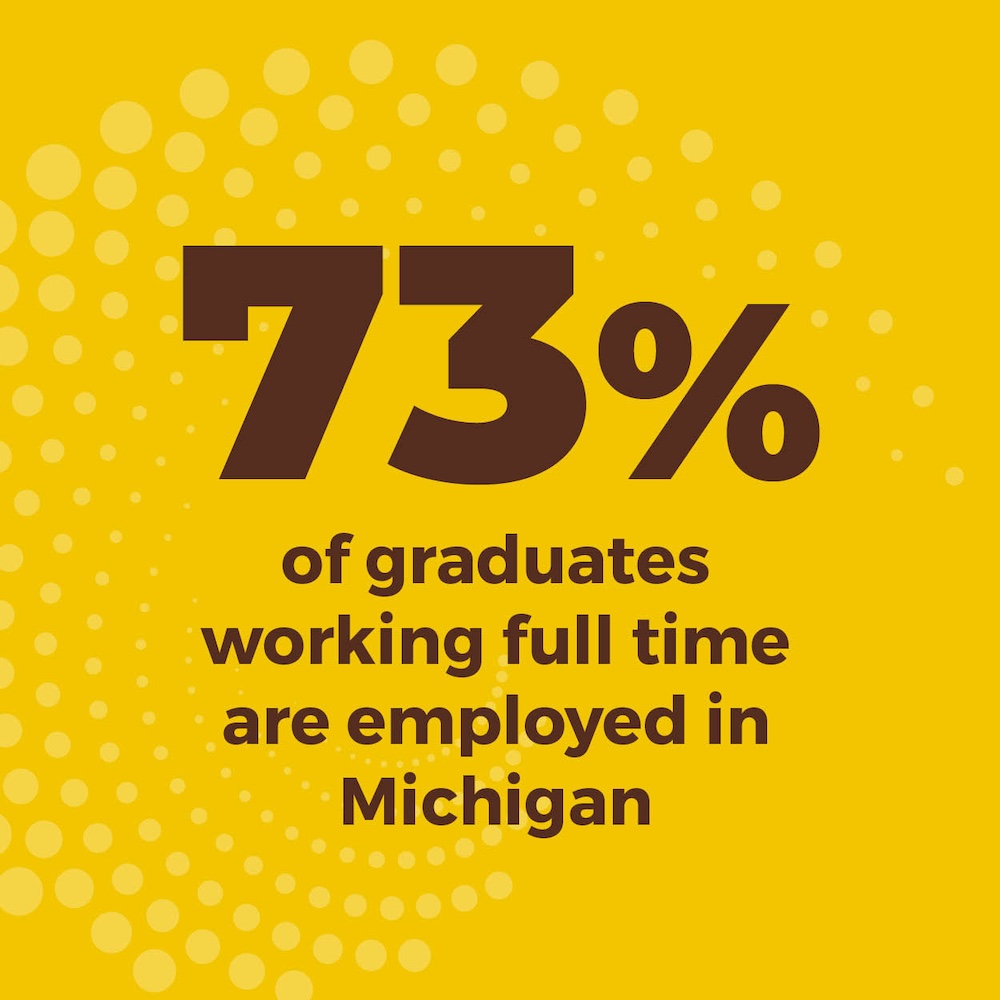
Through WMU's 2024-25 Post-graduation Activity Survey of graduates (bachelor's, master's, doctoral and post-baccalaureate certificate), the University collected data for a total of 3,124 graduates, or 78%, of those who earned their degrees between August 2024 and June 2025. The data collection cycle ended on Oct. 31, 2025. Based on a total of 2,016 responses from graduates working full time who reported the location of their employer, 1,479 are working in Michigan. Please review the Career Outcomes Report for detailed information about the methodology.
98% of Broncos had instructors who made them excited about learning

Through WMU's 2024-25 Post-graduation Activity Survey of graduates (bachelor's, master's, doctoral and post-baccalaureate certificate), the University collected data for a total of 3,124 graduates, or 78%, of those who earned their degrees between August 2024 and June 2025. The data collection cycle ended on Oct. 31, 2025. Based on 1,775 responses, 1,739 graduates responded "agree" or "strongly agree" to the statement: "I had at least one instructor who made me excited about learning." Please review the Career Outcomes Report for detailed information about the methodology.
93% of graduates felt their instructors cared about them as a person
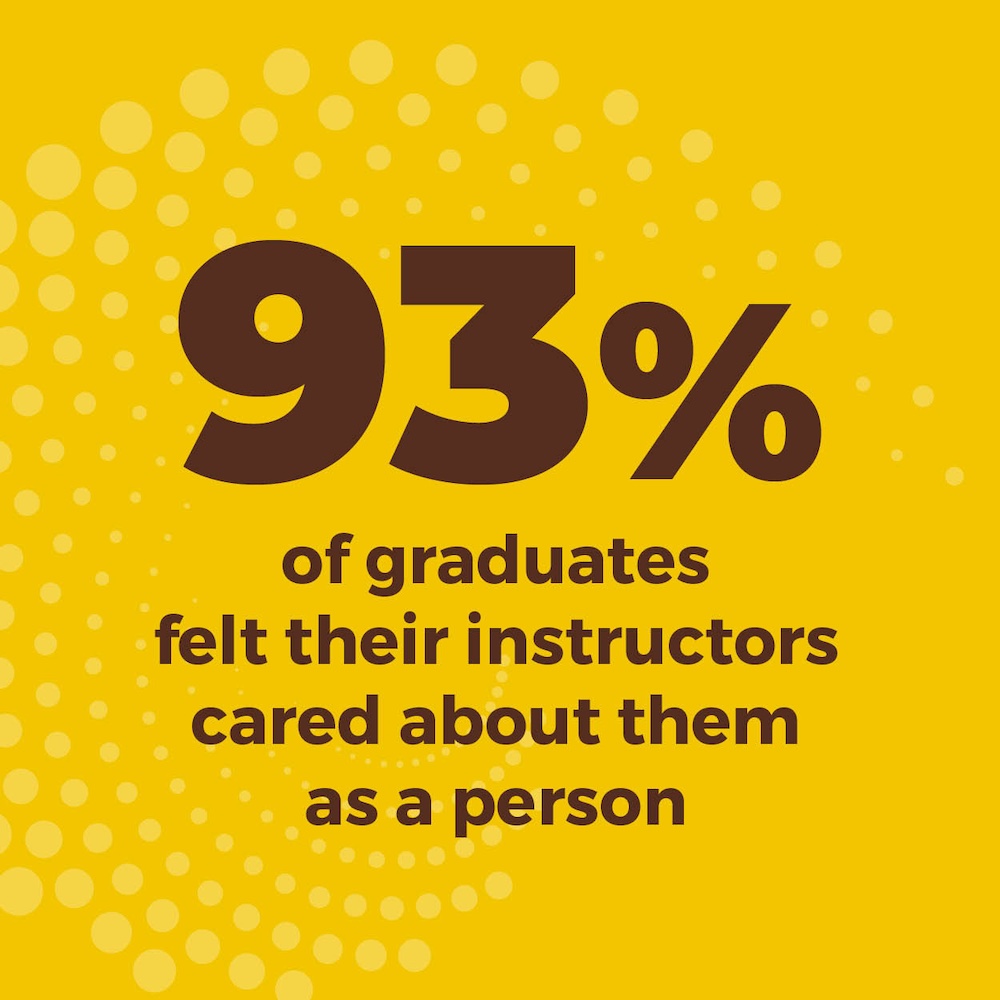
Through WMU's 2024-25 Post-graduation Activity Survey of graduates (bachelor's, master's, doctoral and post-baccalaureate certificate), the University collected data for a total of 3,124 graduates, or 78%, of those who earned their degrees between August 2024 and June 2025. The data collection cycle ended on Oct. 31, 2025. Based on 1,774 responses, a total of 1,657 graduates responded "agree" or "strongly agree" to the statement: "I felt that my instructors cared about me as a person." Please review the Career Outcomes Report for detailed information about the methodology.
92% of graduates say their education and experiences at Western prepared them for their profession
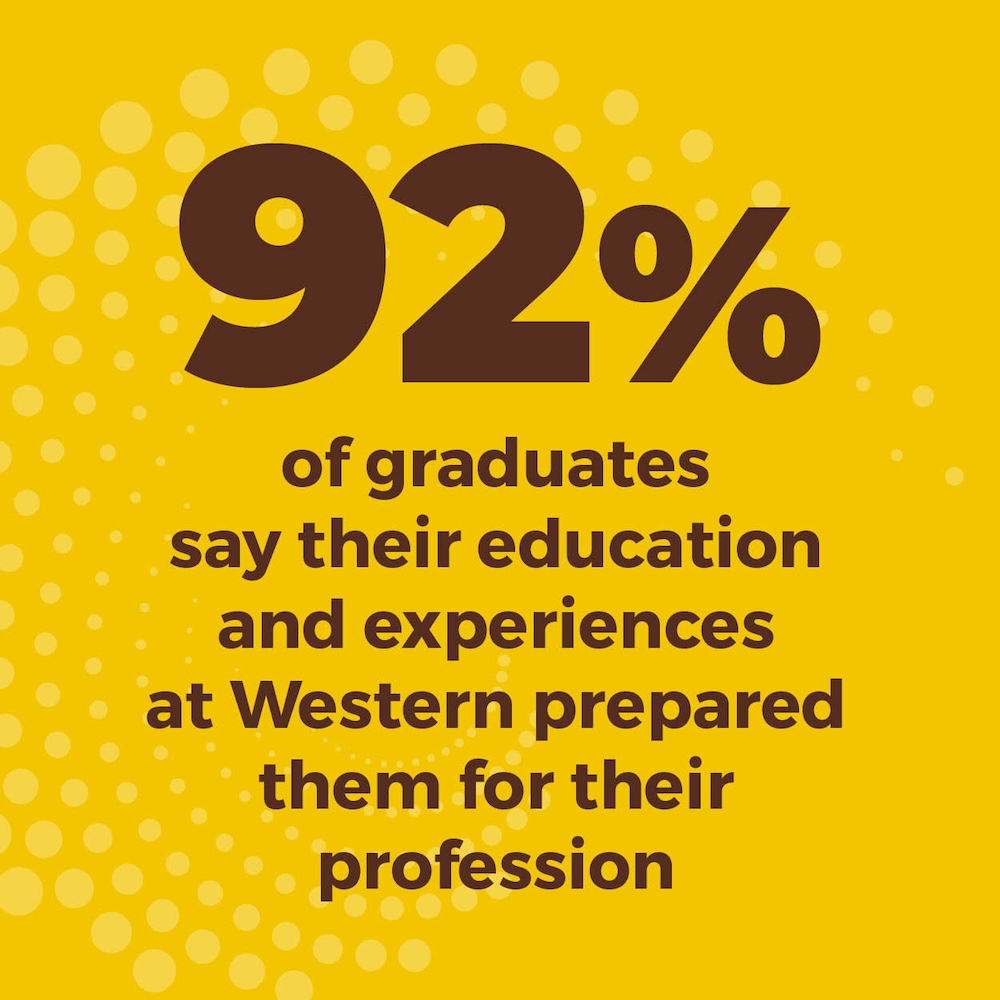
Through WMU's 2024-25 Post-graduation Activity Survey of graduates (bachelor's, master's, doctoral and post-baccalaureate certificate), the University collected data for a total of 3,124 graduates, or 78%, of those who earned their degrees between August 2024 and June 2025. The data collection cycle ended on Oct. 31, 2025. Based on 1,769 responses, a total of 1,621 graduates responded "agree" or "strongly agree" to the statement: "My education and experiences as a student at WMU prepared me for my profession." Please review the Career Outcomes Report for detailed information about the methodology.
$60K-$70K median salary for recent graduates working full time

Through WMU's 2024-25 Post-graduation Activity Survey of graduates (bachelor's, master's, doctoral and post-baccalaureate certificate), the University collected data for a total of 3,124 graduates, or 78%, of those who earned their degrees between August 2024 and June 2025. The data collection cycle ended on Oct. 31, 2025. A total of 881 graduates reported their salary for full-time employment. Please review the Career Outcomes Report for detailed information about the methodology.
19% of graduates are furthering their education

Through WMU's 2024-25 Post-graduation Activity Survey of graduates (bachelor's, master's, doctoral and post-baccalaureate certificate), the University collected data for a total of 3,124 graduates, or 78%, of those who earned their degrees between August 2024 and June 2025. The data collection cycle ended on Oct. 31, 2025. A total of 603 graduates reported they were furthering their education. Please review the Career Outcomes Report for detailed information about the methodology.
$60K-$70K median salary for students working full time after graduate school

Through WMU's 2024-25 Post-graduation Activity Survey of graduates (bachelor's, master's, doctoral and post-baccalaureate certificate), the University collected data for a total of 3,124 graduates, or 78%, of those who earned their degrees between August 2024 and June 2025. The data collection cycle ended on Oct. 31, 2025. A total of 410 graduate students who completed their degree reported their salary for full-time employment. Please review the Career Outcomes Report for detailed information about the methodology.
Top 100 in the nation for graduate programs in occupational therapy and social work
Western Michigan University graduate programs that ranked in the top 100 by U.S. News and World Report were occupational therapy (No. 31 - tie) and social work (No. 95 - tie). For the 2026 Best Graduate Colleges ranking, U.S. News and World Report evaluated institutions based on expert opinion about program excellence from reputation surveys sent to thousands of academics and professionals conducted in fall 2025 and early 2026. To gather the peer assessment data, U.S. News asked deans, program directors and senior faculty to judge the academic quality of programs in their field on a scale of 1 (marginal) to 5 (outstanding). Please review U.S. News and World Report for detailed information about Western's graduate program rankings.
97% of graduate students are working or continuing their education after earning their degree

Through WMU's 2024-25 Post-graduation Activity Survey of graduates (bachelor's, master's, doctoral and post-baccalaureate certificate), the University collected data for a total of 3,124 graduates, or 78%, of those who earned their degrees between August 2024 and June 2025. The data collection cycle ended on Oct. 31, 2025. Based on 1,126 responses from graduate students who completed their degree, 948 were employed full time, 22 were employed part time, 118 were continuing their education, 4 were engaged in military service and 1 was volunteering full time. Please review the Career Outcomes Report for detailed information about the methodology.
96% of graduate students working full time after graduation have a job related to their degree
Through WMU's 2024-25 Post-graduation Activity Survey of graduates (bachelor's, master's, doctoral and post-baccalaureate certificate), the University collected data for a total of 3,124 graduates, or 78%, of those who earned their degrees between August 2024 and June 2025. The data collection cycle ended on Oct. 31, 2025. Based on 784 responses from graduate students who completed their degree and are working full time, a total of 754 responded "yes" to the question: "Is your job related to your degree?" Please review the Career Outcomes Report for detailed information about the methodology.
97% of graduate students felt their instructors cared about them as a person
Through WMU's 2024-25 Post-graduation Activity Survey of graduates (bachelor's, master's, doctoral and post-baccalaureate certificate), the University collected data for a total of 3,124 graduates, or 78%, of those who earned their degrees between August 2024 and June 2025. The data collection cycle ended on Oct. 31, 2025. Based on 658 responses, a total of 635 graduate students who completed their degree responded "agree" or "strongly agree" to the statement: "I felt that my instructors cared about me as a person." Please review the Career Outcomes Report for detailed information about the methodology.
95% of graduate students say their education and experiences at Western prepared them for their profession
Through WMU's 2024-25 Post-graduation Activity Survey of graduates (bachelor's, master's, doctoral and post-baccalaureate certificate), the University collected data for a total of 3,124 graduates, or 78%, of those who earned their degrees between August 2024 and June 2025. The data collection cycle ended on Oct. 31, 2025. Based on 654 responses from graduate students who earned their degree, a total of 619 graduates responded "agree" or "strongly agree" to the statement: "My education and experiences as a student at WMU prepared me for my profession." Please review the Career Outcomes Report for detailed information about the methodology.
99% of graduate students had instructors who made them excited about learning
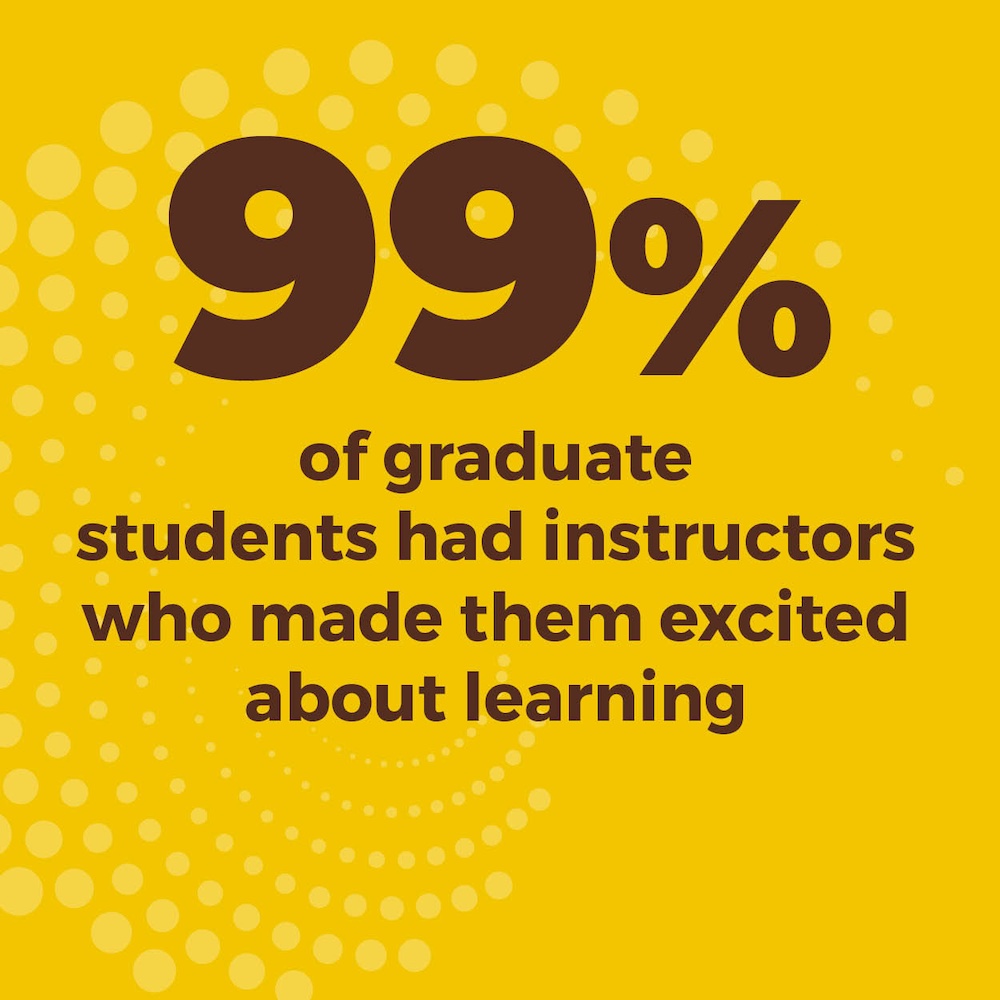
Through WMU's 2024-25 Post-graduation Activity Survey of graduates (bachelor's, master's, doctoral and post-baccalaureate certificate), the University collected data for a total of 3,124 graduates, or 78%, of those who earned their degrees between August 2024 and June 2025. The data collection cycle ended on Oct. 31, 2025. Based on 659 responses from graduate students who earned their degree, 650 graduates responded "agree" or "strongly agree" to the statement: "I had at least one instructor who made me excited about learning." Please review the Career Outcomes Report for detailed information about the methodology.
College and academic program data
94% of aviation graduates are working or continuing their education
Through WMU's 2024-25 Post-graduation Activity Survey of graduates (bachelor's, master's, doctoral and post-baccalaureate certificate), the University collected data for a total of 3,124 graduates, or 78%, of those who earned their degrees between August 2024 and June 2025. The data collection cycle ended on Oct. 31, 2025. Based on 108 responses from College of Aviation graduates, 77 were employed full time, 3 were employed part time, 3 were engaged in military service and 18 employed their degree to gain admittance to graduate school or were otherwise continuing their education. Please review the Career Outcomes Report for detailed information about the methodology.
92% of aviation graduates had instructors who made them excited about learning
Through WMU's 2024-25 Post-graduation Activity Survey of graduates (bachelor's, master's, doctoral and post-baccalaureate certificate), the University collected data for a total of 3,124 graduates, or 78%, of those who earned their degrees between August 2024 and June 2025. The data collection cycle ended on Oct. 31, 2025. Based on 49 responses from College of Aviation graduates, 45 graduates responded "agree" or "strongly agree" to the statement: "I had at least one instructor who made me excited about learning." Please review the Career Outcomes Report for detailed information about the methodology.
98% of College of Health and Human Services graduates working full time have a job related to their degree
Through WMU's 2024-25 Post-graduation Activity Survey of graduates (bachelor's, master's, doctoral and post-baccalaureate certificate), the University collected data for a total of 3,124 graduates, or 78%, of those who earned their degrees between August 2024 and June 2025. The data collection cycle ended on Oct. 31, 2025. Based on 253 responses from College of Health and Human Services graduates working full time, a total of 248 graduates responded "yes" to the question: "Is your job related to your degree?" Please review the Career Outcomes Report for detailed information about the methodology.
95% of College of Health and Human Services graduates participated in experience-driven learning
Through WMU's 2024-25 Post-graduation Activity Survey of graduates (bachelor's, master's, doctoral and post-baccalaureate certificate), the University collected data for a total of 3,124 graduates, or 78%, of those who earned their degrees between August 2024 and June 2025. The data collection cycle ended on Oct. 31, 2025. A total of 254 College of Health and Human Services graduates reported having participated in experiential learning, based on 266 responses. Please review the Career Outcomes Report for detailed information about the methodology.
98% of College of Health and Human Services undergraduates had instructors who made them excited about learning
Through WMU's 2024-25 Post-graduation Activity Survey of graduates (bachelor's, master's, doctoral and post-baccalaureate certificate), the University collected data for a total of 3,124 graduates, or 78%, of those who earned their degrees between August 2024 and June 2025. The data collection cycle ended on Oct. 31, 2025. Based on 133 responses from College of Health and Human Services bachelor's degree graduates, 131 graduates responded "agree" or "strongly agree" to the statement: "I had at least one instructor who made me excited about learning." Please review the Career Outcomes Report for detailed information about the methodology.
100% of healthcare services and sciences graduates participated in experience-driven learning
Through WMU's 2024-25 Post-graduation Activity Survey of graduates (bachelor's, master's, doctoral and post-baccalaureate certificate), the University collected data for a total of 3,124 graduates, or 78%, of those who earned their degrees between August 2024 and June 2025. The data collection cycle ended on Oct. 31, 2025. A total of 11 healthcare services and sciences graduates reported having participated in experiential learning, based on 11 responses. Please review the Career Outcomes Report for detailed information about the methodology.
100% of healthcare services and sciences graduates are working or continuing their education
Through WMU's 2024-25 Post-graduation Activity Survey of graduates (bachelor's, master's, doctoral and post-baccalaureate certificate), the University collected data for a total of 3,124 graduates, or 78%, of those who earned their degrees between August 2024 and June 2025. The data collection cycle ended on Oct. 31, 2025. Based on 22 responses from graduates with a healthcare services and sciences degree, 11 were employed full time, 1 was employed part time and 10 employed their degree to gain admittance to graduate school or were otherwise continuing their education. Please review the Career Outcomes Report for detailed information about the methodology.
100% of healthcare services and sciences graduates had instructors who made them excited about learning
Through WMU's 2024-25 Post-graduation Activity Survey of graduates (bachelor's, master's, doctoral and post-baccalaureate certificate), the University collected data for a total of 3,124 graduates, or 78%, of those who earned their degrees between August 2024 and June 2025. The data collection cycle ended on Oct. 31, 2025. Based on 11 responses from healthcare services and sciences graduates, 11 graduates responded "agree" or "strongly agree" to the statement: "I had at least one instructor who made me excited about learning." Please review the Career Outcomes Report for detailed information about the methodology.
91% of healthcare services and sciences graduates felt their instructors cared about them as a person
Through WMU's 2024-25 Post-graduation Activity Survey of graduates (bachelor's, master's, doctoral and post-baccalaureate certificate), the University collected data for a total of 3,124 graduates, or 78%, of those who earned their degrees between August 2024 and June 2025. The data collection cycle ended on Oct. 31, 2025. Based on 11 responses from healthcare services and sciences graduates, a total of 10 graduates responded "agree" or "strongly agree" to the statement: "I felt that my instructors cared about me as a person." Please review the Career Outcomes Report for detailed information about the methodology.
96% of School of Interdisciplinary Health Programs undergraduates are working or continuing their education
Through WMU's 2024-25 Post-graduation Activity Survey of graduates (bachelor's, master's, doctoral and post-baccalaureate certificate), the University collected data for a total of 3,124 graduates, or 78%, of those who earned their degrees between August 2024 and June 2025. The data collection cycle ended on Oct. 31, 2025. Based on 50 responses from School of Interdisciplinary Health Programs graduates who earned a bachelor's degree, 20 were employed full time, 1 was employed part time and 27 employed their degree to gain admittance to graduate school or were otherwise continuing their education. Please review the Career Outcomes Report for detailed information about the methodology.
100% of physical therapy graduates working full time have a job related to their degree
Through WMU's 2024-25 Post-graduation Activity Survey of graduates (bachelor's, master's, doctoral and post-baccalaureate certificate), the University collected data for a total of 3,124 graduates, or 78%, of those who earned their degrees between August 2024 and June 2025. The data collection cycle ended on Oct. 31, 2025. Based on 24 responses from physical therapy graduates working full time, a total of 24 graduates responded "yes" to the question: "Is your job related to your degree?" Please review the Career Outcomes Report for detailed information about the methodology.
100% of physical therapy graduates working full time are satisfied with their job
Through WMU's 2024-25 Post-graduation Activity Survey of graduates (bachelor's, master's, doctoral and post-baccalaureate certificate), the University collected data for a total of 3,124 graduates, or 78%, of those who earned their degrees between August 2024 and June 2025. The data collection cycle ended on Oct. 31, 2025. Based on 7 responses from physical therapy graduates working full time, a total of 7 graduates responded "yes" to the question: "Are you satisfied with your job?" Please review the Career Outcomes Report for detailed information about the methodology.
100% of physician assistant graduates had a mentor who encouraged them to pursue their goals and dreams
Through WMU's 2024-25 Post-graduation Activity Survey of graduates (bachelor's, master's, doctoral and post-baccalaureate certificate), the University collected data for a total of 3,124 graduates, or 78%, of those who earned their degrees between August 2024 and June 2025. The data collection cycle ended on Oct. 31, 2025. Based on 10 responses from physician assistant graduates, 10 graduates responded "agree" or "strongly agree" to the statement: "I had a mentor who encouraged me to pursue my goals and dreams." Please review the Career Outcomes Report for detailed information about the methodology.
100% of Bronson School of Nursing graduates working full time have a job related to their degree
Through WMU's 2024-25 Post-graduation Activity Survey of graduates (bachelor's, master's, doctoral and post-baccalaureate certificate), the University collected data for a total of 3,124 graduates, or 78%, of those who earned their degrees between August 2024 and June 2025. The data collection cycle ended on Oct. 31, 2025. Based on 58 responses from Bronson School of Nursing graduates working full time, a total of 58 graduates responded "yes" to the question: "Is your job related to your degree?" Please review the Career Outcomes Report for detailed information about the methodology.
$60K-$70K median starting salary for recent Bronson School of Nursing graduates working full time
Through WMU's 2024-25 Post-graduation Activity Survey of graduates (bachelor's, master's, doctoral and post-baccalaureate certificate), the University collected data for a total of 3,124 graduates, or 78%, of those who earned their degrees between August 2024 and June 2025. The data collection cycle ended on Oct. 31, 2025. A total of 31 Bronson School of Nursing graduates reported their salary for full-time employment. Please review the Career Outcomes Report for detailed information about the methodology.
100% of occupational therapy graduates participated in experience-driven learning
Through WMU's 2024-25 Post-graduation Activity Survey of graduates (bachelor's, master's, doctoral and post-baccalaureate certificate), the University collected data for a total of 3,124 graduates, or 78%, of those who earned their degrees between August 2024 and June 2025. The data collection cycle ended on Oct. 31, 2025. A total of 30 occupational therapy graduates reported having participated in experiential learning, based on 30 responses. Please review the Career Outcomes Report for detailed information about the methodology.
100% of public health graduates say their education and experiences at Western prepared them for their profession
Through WMU's 2024-25 Post-graduation Activity Survey of graduates (bachelor's, master's, doctoral and post-baccalaureate certificate), the University collected data for a total of 3,124 graduates, or 78%, of those who earned their degrees between August 2024 and June 2025. The data collection cycle ended on Oct. 31, 2025. Based on 11 responses from public health graduates, a total of 11 graduates responded "agree" or "strongly agree" to the statement: "My education and experiences as a student at WMU prepared me for my profession." Please review the Career Outcomes Report for detailed information about the methodology.
100% of School of Social Work graduate students had an internship where they applied what they were learning in the classroom
Through WMU's 2024-25 Post-graduation Activity Survey of graduates (bachelor's, master's, doctoral and post-baccalaureate certificate), the University collected data for a total of 3,124 graduates, or 78%, of those who earned their degrees between August 2024 and June 2025. The data collection cycle ended on Oct. 31, 2025. Out of 34 responses, a total of 34 School of Social Work students who earned a graduate degree reported having an internship, co-op, practicum or field experience where they applied what they were learning in the classroom. Please review the Career Outcomes Report for detailed information about the methodology.
100% of speech, language and hearing sciences graduate students had an internship where they applied what they were learning in the classroom
Through WMU's 2024-25 Post-graduation Activity Survey of graduates (bachelor's, master's, doctoral and post-baccalaureate certificate), the University collected data for a total of 3,124 graduates, or 78%, of those who earned their degrees between August 2024 and June 2025. The data collection cycle ended on Oct. 31, 2025. Out of 15 responses, a total of 15 speech, language and hearing sciences students who earned a graduate degree reported having an internship, co-op, practicum or field experience where they applied what they were learning in the classroom. Please review the Career Outcomes Report for detailed information about the methodology.
93% of College of Engineering and Applied Sciences graduates are working or continuing their education
Through WMU's 2024-25 Post-graduation Activity Survey of graduates (bachelor's, master's, doctoral and post-baccalaureate certificate), the University collected data for a total of 3,124 graduates, or 78%, of those who earned their degrees between August 2024 and June 2025. The data collection cycle ended on Oct. 31, 2025. Based on 366 responses from College of Engineering and Applied Sciences graduates, 299 were employed full time, 4 were employed part time, 5 were engaged in military service and 31 employed their degree to gain admittance to graduate school or were otherwise continuing their education. Please review the Career Outcomes Report for detailed information about the methodology.
97% of College of Engineering and Applied Sciences graduates working full time have a job related to their degree
Through WMU's 2024-25 Post-graduation Activity Survey of graduates (bachelor's, master's, doctoral and post-baccalaureate certificate), the University collected data for a total of 3,124 graduates, or 78%, of those who earned their degrees between August 2024 and June 2025. The data collection cycle ended on Oct. 31, 2025. Based on 228 responses from College of Engineering and Applied Sciences graduates working full time, a total of 222 graduates responded "yes" to the question: "Is your job related to your degree?" Please review the Career Outcomes Report for detailed information about the methodology.
99% of College of Engineering and Applied Sciences graduates working full time are satisfied with their job
Through WMU's 2024-25 Post-graduation Activity Survey of graduates (bachelor's, master's, doctoral and post-baccalaureate certificate), the University collected data for a total of 3,124 graduates, or 78%, of those who earned their degrees between August 2024 and June 2025. The data collection cycle ended on Oct. 31, 2025. Based on 126 responses from College of Engineering and Applied Sciences graduates working full time, a total of 125 graduates responded "yes" to the question: "Are you satisfied with your job?" Please review the Career Outcomes Report for detailed information about the methodology.
$70K-$80K median starting salary for recent College of Engineering and Applied Sciences graduates working full time
Through WMU's 2024-25 Post-graduation Activity Survey of graduates (bachelor's, master's, doctoral and post-baccalaureate certificate), the University collected data for a total of 3,124 graduates, or 78%, of those who earned their degrees between August 2024 and June 2025. The data collection cycle ended on Oct. 31, 2025. A total of 122 College of Engineering and Applied Sciences graduates reported their salary for full-time employment. Please review the Career Outcomes Report for detailed information about the methodology.
100% of recent master's and Ph.D. College of Engineering and Applied Sciences graduates working full time have a job related to their degree
Through WMU's 2024-25 Post-graduation Activity Survey of graduates (bachelor's, master's, doctoral and post-baccalaureate certificate), the University collected data for a total of 3,124 graduates, or 78%, of those who earned their degrees between August 2024 and June 2025. The data collection cycle ended on Oct. 31, 2025. Based on 69 responses from College of Engineering and Applied Sciences students who earned a graduate degree and are working full time, a total of 69 graduates responded "yes" to the question: "Is your job related to your degree?" Please review the Career Outcomes Report for detailed information about the methodology.
100% of civil and construction engineering graduates are working or continuing their education
Through WMU's 2024-25 Post-graduation Activity Survey of graduates (bachelor's, master's, doctoral and post-baccalaureate certificate), the University collected data for a total of 3,124 graduates, or 78%, of those who earned their degrees between August 2024 and June 2025. The data collection cycle ended on Oct. 31, 2025. Based on 34 responses from graduates with a civil engineering or construction engineering degree, 31 were employed full time, 1 was engaged in military service and 2 employed their degree to gain admittance to graduate school or were otherwise continuing their education. Please review the Career Outcomes Report for detailed information about the methodology.
100% of electrical and computer engineering graduates are working or continuing their education
Through WMU's 2024-25 Post-graduation Activity Survey of graduates (bachelor's, master's, doctoral and post-baccalaureate certificate), the University collected data for a total of 3,124 graduates, or 78%, of those who earned their degrees between August 2024 and June 2025. The data collection cycle ended on Oct. 31, 2025. Based on 35 responses from graduates with a degree in computer engineering, electrical engineering, or computer and electrical engineering, 31 were employed full time, 1 was employed part time, 2 were engaged in military service and 1 employed their degree to gain admittance to graduate school or were otherwise continuing their education. Please review the Career Outcomes Report for detailed information about the methodology.
$100K+ median starting salary for recent master's and Ph.D. graduates in mechanical and aerospace engineering working full time
Through WMU's 2024-25 Post-graduation Activity Survey of graduates (bachelor's, master's, doctoral and post-baccalaureate certificate), the University collected data for a total of 3,124 graduates, or 78%, of those who earned their degrees between August 2024 and June 2025. The data collection cycle ended on Oct. 31, 2025. A total of 8 students who earned a graduate degree in aerospace engineering or mechanical engineering reported their salary for full-time employment. Please review the Career Outcomes Report for detailed information about the methodology.
98% of College of Engineering and Applied Sciences undergraduates participated in experience-driven learning
Through WMU's 2024-25 Post-graduation Activity Survey of graduates (bachelor's, master's, doctoral and post-baccalaureate certificate), the University collected data for a total of 3,124 graduates, or 78%, of those who earned their degrees between August 2024 and June 2025. The data collection cycle ended on Oct. 31, 2025. A total of 163 College of Engineering and Applied Sciences bachelor's degree graduates reported having participated in experiential learning, based on 166 responses. Please review the Career Outcomes Report for detailed information about the methodology.
100% of civil and construction engineering graduates working full time have a job related to their degree
Through WMU's 2024-25 Post-graduation Activity Survey of graduates (bachelor's, master's, doctoral and post-baccalaureate certificate), the University collected data for a total of 3,124 graduates, or 78%, of those who earned their degrees between August 2024 and June 2025. The data collection cycle ended on Oct. 31, 2025. Based on 27 responses from graduates with a civil engineering or construction engineering degree working full time, a total of 27 graduates responded "yes" to the question: "Is your job related to your degree?" Please review the Career Outcomes Report for detailed information about the methodology.
100% of civil and construction engineering graduates working full time are satisfied with their job
Through WMU's 2024-25 Post-graduation Activity Survey of graduates (bachelor's, master's, doctoral and post-baccalaureate certificate), the University collected data for a total of 3,124 graduates, or 78%, of those who earned their degrees between August 2024 and June 2025. The data collection cycle ended on Oct. 31, 2025. Based on 16 responses from graduates with a civil engineering or construction engineering degree working full time, a total of 16 graduates responded "yes" to the question: "Are you satisfied with your job?" Please review the Career Outcomes Report for detailed information about the methodology.
100% of electrical and computer engineering graduates working full time have a job related to their degree
Through WMU's 2024-25 Post-graduation Activity Survey of graduates (bachelor's, master's, doctoral and post-baccalaureate certificate), the University collected data for a total of 3,124 graduates, or 78%, of those who earned their degrees between August 2024 and June 2025. The data collection cycle ended on Oct. 31, 2025. Based on 29 responses from graduates with a degree in computer engineering, electrical engineering, or computer and electrical engineering who were working full time, a total of 29 graduates responded "yes" to the question: "Is your job related to your degree?" Please review the Career Outcomes Report for detailed information about the methodology.
100% of recent master's and Ph.D. College of Engineering and Applied Sciences graduates working full time are satisfied with their job
Through WMU's 2024-25 Post-graduation Activity Survey of graduates (bachelor's, master's, doctoral and post-baccalaureate certificate), the University collected data for a total of 3,124 graduates, or 78%, of those who earned their degrees between August 2024 and June 2025. The data collection cycle ended on Oct. 31, 2025. Based on 24 responses from College of Engineering and Applied Sciences students who earned a graduate degree and are working full time, a total of 24 graduates responded "yes" to the question: "Are you satisfied with your job?" Please review the Career Outcomes Report for detailed information about the methodology.
$80K-$90K median starting salary for recent chemical and paper engineering graduates working full time
Through WMU's 2024-25 Post-graduation Activity Survey of graduates (bachelor's, master's, doctoral and post-baccalaureate certificate), the University collected data for a total of 3,124 graduates, or 78%, of those who earned their degrees between August 2024 and June 2025. The data collection cycle ended on Oct. 31, 2025. A total of 13 Department of Chemical and Paper Engineering graduates reported their salary for full-time employment. Please review the Career Outcomes Report for detailed information about the methodology.
100% of graduate cybersecurity students had instructors who made them excited about learning
Through WMU's 2024-25 Post-graduation Activity Survey of graduates (bachelor's, master's, doctoral and post-baccalaureate certificate), the University collected data for a total of 3,124 graduates, or 78%, of those who earned their degrees between August 2024 and June 2025. The data collection cycle ended on Oct. 31, 2025. Based on 7 responses from Master of Science in cybersecurity students who earned a graduate degree, 7 graduates responded "agree" or "strongly agree" to the statement: "I had at least one instructor who made me excited about learning." Please review the Career Outcomes Report for detailed information about the methodology.
94% of graduate cybersecurity students are working or continuing their education quickly after earning their degree
Through WMU's 2024-25 Post-graduation Activity Survey of graduates (bachelor's, master's, doctoral and post-baccalaureate certificate), the University collected data for a total of 3,124 graduates, or 78%, of those who earned their degrees between August 2024 and June 2025. The data collection cycle ended on Oct. 31, 2025. Based on 18 responses from students who earned a Master of Science in cybersecurity graduate degree, 16 were employed full time and 1 employed their degree to gain admittance to graduate school or was otherwise continuing their education. Please review the Career Outcomes Report for detailed information about the methodology.
100% of graduate cybersecurity students working full time have a job related to their degree
Through WMU's 2024-25 Post-graduation Activity Survey of graduates (bachelor's, master's, doctoral and post-baccalaureate certificate), the University collected data for a total of 3,124 graduates, or 78%, of those who earned their degrees between August 2024 and June 2025. The data collection cycle ended on Oct. 31, 2025. Based on 6 responses from Master of Science in cybersecurity students who earned a graduate degree and are working full time, a total of 6 graduates responded "yes" to the question: "Is your job related to your degree?" Please review the Career Outcomes Report for detailed information about the methodology.
95% of College of Education and Human Development graduates are working or continuing their education
Through WMU's 2024-25 Post-graduation Activity Survey of graduates (bachelor's, master's, doctoral and post-baccalaureate certificate), the University collected data for a total of 3,124 graduates, or 78%, of those who earned their degrees between August 2024 and June 2025. The data collection cycle ended on Oct. 31, 2025. Based on 685 responses from College of Education and Human Development graduates, 563 were employed full time, 12 were employed part time, 1 was engaged in military service and 78 employed their degree to gain admittance to graduate school or were otherwise continuing their education. Please review the Career Outcomes Report for detailed information about the methodology.
97% of College of Education and Human Development graduates working full time have a job related to their degree
Through WMU's 2024-25 Post-graduation Activity Survey of graduates (bachelor's, master's, doctoral and post-baccalaureate certificate), the University collected data for a total of 3,124 graduates, or 78%, of those who earned their degrees between August 2024 and June 2025. The data collection cycle ended on Oct. 31, 2025. Based on 485 responses from College of Education and Human Development graduates working full time, a total of 470 graduates responded "yes" to the question: "Is your job related to your degree?" Please review the Career Outcomes Report for detailed information about the methodology.
98% of College of Education and Human Development undergraduates participated in experience-driven learning
Through WMU's 2024-25 Post-graduation Activity Survey of graduates (bachelor's, master's, doctoral and post-baccalaureate certificate), the University collected data for a total of 3,124 graduates, or 78%, of those who earned their degrees between August 2024 and June 2025. The data collection cycle ended on Oct. 31, 2025. A total of 122 College of Education and Human Development bachelor's degree graduates reported having participated in experiential learning, based on 124 responses. Please review the Career Outcomes Report for detailed information about the methodology.
97% of teaching, learning and educational studies graduates working full time are satisfied with their jobs
Through WMU's 2024-25 Post-graduation Activity Survey of graduates (bachelor's, master's, doctoral and post-baccalaureate certificate), the University collected data for a total of 3,124 graduates, or 78%, of those who earned their degrees between August 2024 and June 2025. The data collection cycle ended on Oct. 31, 2025. Based on 39 responses from Department of Teaching, Learning and Educational Studies graduates working full time, a total of 38 graduates responded "yes" to the question: "Are you satisfied with your job?" Please review the Career Outcomes Report for detailed information about the methodology.
95% of teaching, learning and educational studies graduates working full time have a job related to their degree
Through WMU's 2024-25 Post-graduation Activity Survey of graduates (bachelor's, master's, doctoral and post-baccalaureate certificate), the University collected data for a total of 3,124 graduates, or 78%, of those who earned their degrees between August 2024 and June 2025. The data collection cycle ended on Oct. 31, 2025. Based on 60 responses from Department of Teaching, Learning and Educational Studies graduates working full time, a total of 57 graduates responded "yes" to the question: "Is your job related to your degree?" Please review the Career Outcomes Report for detailed information about the methodology.
99% of special education and literacy studies graduates are working or continuing their education
Through WMU's 2024-25 Post-graduation Activity Survey of graduates (bachelor's, master's, doctoral and post-baccalaureate certificate), the University collected data for a total of 3,124 graduates, or 78%, of those who earned their degrees between August 2024 and June 2025. The data collection cycle ended on Oct. 31, 2025. Based on 232 responses from Department of Special Education and Literacy Studies graduates, 226 were employed full time and 4 employed their degree to gain admittance to graduate school or were otherwise continuing their education. Please review the Career Outcomes Report for detailed information about the methodology.
95% of human performance and health education graduates are working or continuing their education
Through WMU's 2024-25 Post-graduation Activity Survey of graduates (bachelor's, master's, doctoral and post-baccalaureate certificate), the University collected data for a total of 3,124 graduates, or 78%, of those who earned their degrees between August 2024 and June 2025. The data collection cycle ended on Oct. 31, 2025. Based on 126 responses from Department of Human Performance and Health Education graduates, 70 were employed full time, 2 were employed part time, 1 was engaged in military service and 47 employed their degree to gain admittance to graduate school or were otherwise continuing their education. Please review the Career Outcomes Report for detailed information about the methodology.
94% of family and consumer sciences graduates are working or continuing their education
Through WMU's 2024-25 Post-graduation Activity Survey of graduates (bachelor's, master's, doctoral and post-baccalaureate certificate), the University collected data for a total of 3,124 graduates, or 78%, of those who earned their degrees between August 2024 and June 2025. The data collection cycle ended on Oct. 31, 2025. Based on 86 responses from Department of Family and Consumer Sciences graduates, 65 were employed full time, 3 were employed part time and 13 employed their degree to gain admittance to graduate school or were otherwise continuing their education. Please review the Career Outcomes Report for detailed information about the methodology.
92% of College of Fine Arts graduates working full time have a job related to their degree
Through WMU's 2024-25 Post-graduation Activity Survey of graduates (bachelor's, master's, doctoral and post-baccalaureate certificate), the University collected data for a total of 3,124 graduates, or 78%, of those who earned their degrees between August 2024 and June 2025. The data collection cycle ended on Oct. 31, 2025. Based on 59 responses from College of Fine Arts graduates working full time, a total of 54 graduates responded "yes" to the question: "Is your job related to your degree?" Please review the Career Outcomes Report for detailed information about the methodology.
97% of College of Fine Arts graduates working full time are satisfied with their job
Through WMU's 2024-25 Post-graduation Activity Survey of graduates (bachelor's, master's, doctoral and post-baccalaureate certificate), the University collected data for a total of 3,124 graduates, or 78%, of those who earned their degrees between August 2024 and June 2025. The data collection cycle ended on Oct. 31, 2025. Based on 38 responses from College of Fine Arts graduates working full time, a total of 37 graduates responded "yes" to the question: "Are you satisfied with your job?" Please review the Career Outcomes Report for detailed information about the methodology.
96% of College of Fine Arts graduates participated in experience-driven learning
Through WMU's 2024-25 Post-graduation Activity Survey of graduates (bachelor's, master's, doctoral and post-baccalaureate certificate), the University collected data for a total of 3,124 graduates, or 78%, of those who earned their degrees between August 2024 and June 2025. The data collection cycle ended on Oct. 31, 2025. A total of 93 College of Fine Arts graduates reported having participated in experiential learning, based on 97 responses. Please review the Career Outcomes Report for detailed information about the methodology.
100% of College of Fine Arts graduates had instructors who made them excited about learning
Through WMU's 2024-25 Post-graduation Activity Survey of graduates (bachelor's, master's, doctoral and post-baccalaureate certificate), the University collected data for a total of 3,124 graduates, or 78%, of those who earned their degrees between August 2024 and June 2025. The data collection cycle ended on Oct. 31, 2025. Based on 94 responses from College of Fine Arts graduates, 94 graduates responded "agree" or "strongly agree" to the statement: "I had at least one instructor who made me excited about learning." Please review the Career Outcomes Report for detailed information about the methodology.
97% of College of Fine Arts graduates felt their instructors cared about them as a person
Through WMU's 2024-25 Post-graduation Activity Survey of graduates (bachelor's, master's, doctoral and post-baccalaureate certificate), the University collected data for a total of 3,124 graduates, or 78%, of those who earned their degrees between August 2024 and June 2025. The data collection cycle ended on Oct. 31, 2025. Based on 94 responses from College of Fine Arts graduates, a total of 91 graduates responded "agree" or "strongly agree" to the statement: "I felt that my instructors cared about me as a person." Please review the Career Outcomes Report for detailed information about the methodology.
91% of College of Fine Arts graduates say their education and experiences at Western prepared them for their profession
Through WMU's 2024-25 Post-graduation Activity Survey of graduates (bachelor's, master's, doctoral and post-baccalaureate certificate), the University collected data for a total of 3,124 graduates, or 78%, of those who earned their degrees between August 2024 and June 2025. The data collection cycle ended on Oct. 31, 2025. Based on 94 responses from College of Fine Arts graduates, a total of 86 graduates responded "agree" or "strongly agree" to the statement: "My education and experiences as a student at WMU prepared me for my profession." Please review the Career Outcomes Report for detailed information about the methodology.
90% of College of Fine Arts graduates had a mentor who encouraged them to pursue their goals and dreams
Through WMU's 2024-25 Post-graduation Activity Survey of graduates (bachelor's, master's, doctoral and post-baccalaureate certificate), the University collected data for a total of 3,124 graduates, or 78%, of those who earned their degrees between August 2024 and June 2025. The data collection cycle ended on Oct. 31, 2025. Based on 94 responses from College of Fine Arts graduates, 85 graduates responded "agree" or "strongly agree" to the statement: "I had a mentor who encouraged me to pursue my goals and dreams." Please review the Career Outcomes Report for detailed information about the methodology.
100% of theatre graduates working full time are satisfied with their job
Through WMU's 2024-25 Post-graduation Activity Survey of graduates (bachelor's, master's, doctoral and post-baccalaureate certificate), the University collected data for a total of 3,124 graduates, or 78%, of those who earned their degrees between August 2024 and June 2025. The data collection cycle ended on Oct. 31, 2025. Based on 7 responses from Department of Theatre graduates working full time, a total of 7 graduates responded "yes" to the question: "Are you satisfied with your job?" Please review the Career Outcomes Report for detailed information about the methodology.
100% of theatre graduates had instructors who made them excited about learning
Through WMU's 2024-25 Post-graduation Activity Survey of graduates (bachelor's, master's, doctoral and post-baccalaureate certificate), the University collected data for a total of 3,124 graduates, or 78%, of those who earned their degrees between August 2024 and June 2025. The data collection cycle ended on Oct. 31, 2025. Based on 20 responses from Department of Theatre graduates, 20 graduates responded "agree" or "strongly agree" to the statement: "I had at least one instructor who made me excited about learning." Please review the Career Outcomes Report for detailed information about the methodology.
100% of theatre graduates say their education and experiences at Western prepared them for their profession
Through WMU's 2024-25 Post-graduation Activity Survey of graduates (bachelor's, master's, doctoral and post-baccalaureate certificate), the University collected data for a total of 3,124 graduates, or 78%, of those who earned their degrees between August 2024 and June 2025. The data collection cycle ended on Oct. 31, 2025. Based on 20 responses from Department of Theatre graduates, a total of 20 graduates responded "agree" or "strongly agree" to the statement: "My education and experiences as a student at WMU prepared me for my profession." Please review the Career Outcomes Report for detailed information about the methodology.
91% of music graduates working full time have a job related to their degree
Through WMU's 2024-25 Post-graduation Activity Survey of graduates (bachelor's, master's, doctoral and post-baccalaureate certificate), the University collected data for a total of 3,124 graduates, or 78%, of those who earned their degrees between August 2024 and June 2025. The data collection cycle ended on Oct. 31, 2025. Based on 33 responses from Gilmore School of Music graduates working full time, a total of 30 graduates responded "yes" to the question: "Is your job related to your degree?" Please review the Career Outcomes Report for detailed information about the methodology.
95% of music graduates are working or continuing their education
Through WMU's 2024-25 Post-graduation Activity Survey of graduates (bachelor's, master's, doctoral and post-baccalaureate certificate), the University collected data for a total of 3,124 graduates, or 78%, of those who earned their degrees between August 2024 and June 2025. The data collection cycle ended on Oct. 31, 2025. Based on 60 responses from Gilmore School of Music graduates, 38 were employed full time, 3 were employed part time, 1 was engaged in military service and 15 employed their degree to gain admittance to graduate school or were otherwise continuing their education. Please review the Career Outcomes Report for detailed information about the methodology.
91% of music graduates say their education and experiences at Western prepared them for their profession
Through WMU's 2024-25 Post-graduation Activity Survey of graduates (bachelor's, master's, doctoral and post-baccalaureate certificate), the University collected data for a total of 3,124 graduates, or 78%, of those who earned their degrees between August 2024 and June 2025. The data collection cycle ended on Oct. 31, 2025. Based on 43 responses from Gilmore School of Music graduates, a total of 39 graduates responded "agree" or "strongly agree" to the statement: "My education and experiences as a student at WMU prepared me for my profession." Please review the Career Outcomes Report for detailed information about the methodology.
91% of College of Arts and Sciences graduates are working or continuing their education
Through WMU's 2024-25 Post-graduation Activity Survey of graduates (bachelor's, master's, doctoral and post-baccalaureate certificate), the University collected data for a total of 3,124 graduates, or 78%, of those who earned their degrees between August 2024 and June 2025. The data collection cycle ended on Oct. 31, 2025. Based on 658 responses from College of Arts and Sciences graduates, 332 were employed full time, 25 were employed part time, 3 were engaged in military service, 4 were volunteering full time and 237 employed their degree to gain admittance to graduate school or were otherwise continuing their education. Please review the Career Outcomes Report for detailed information about the methodology.
91% of College of Arts and Sciences graduates working full time were satisfied with their job
Through WMU's 2024-25 Post-graduation Activity Survey of graduates (bachelor's, master's, doctoral and post-baccalaureate certificate), the University collected data for a total of 3,124 graduates, or 78%, of those who earned their degrees between August 2024 and June 2025. The data collection cycle ended on Oct. 31, 2025. Based on 131 responses from College of Arts and Sciences graduates working full time, a total of 119 graduates responded "yes" to the question: "Are you satisfied with your job?" Please review the Career Outcomes Report for detailed information about the methodology.
97% of biological sciences graduates are working or continuing their education
Through WMU's 2024-25 Post-graduation Activity Survey of graduates (bachelor's, master's, doctoral and post-baccalaureate certificate), the University collected data for a total of 3,124 graduates, or 78%, of those who earned their degrees between August 2024 and June 2025. The data collection cycle ended on Oct. 31, 2025. Based on 64 responses from Department of Biological Sciences graduates, 28 were employed full time, 1 was employed part time, 1 was engaged in military service, 1 was volunteering full time and 31 employed their degree to gain admittance to graduate school or were otherwise continuing their education. Please review the Career Outcomes Report for detailed information about the methodology.
100% of economics graduates are working or continuing their education
Through WMU's 2024-25 Post-graduation Activity Survey of graduates (bachelor's, master's, doctoral and post-baccalaureate certificate), the University collected data for a total of 3,124 graduates, or 78%, of those who earned their degrees between August 2024 and June 2025. The data collection cycle ended on Oct. 31, 2025. Based on 16 responses from Department of Economics graduates, 6 were employed full time and 10 employed their degree to gain admittance to graduate school or were otherwise continuing their education. Please review the Career Outcomes Report for detailed information about the methodology.
93% of Spanish graduates are working or continuing their education
Through WMU's 2024-25 Post-graduation Activity Survey of graduates (bachelor's, master's, doctoral and post-baccalaureate certificate), the University collected data for a total of 3,124 graduates, or 78%, of those who earned their degrees between August 2024 and June 2025. The data collection cycle ended on Oct. 31, 2025. Based on 30 responses from Department of Spanish graduates, 14 were employed full time, 1 was employed part time, 1 was volunteering full time and 12 employed their degree to gain admittance to graduate school or were otherwise continuing their education. Please review the Career Outcomes Report for detailed information about the methodology.
100% of statistics graduates are working or continuing their education
Through WMU's 2024-25 Post-graduation Activity Survey of graduates (bachelor's, master's, doctoral and post-baccalaureate certificate), the University collected data for a total of 3,124 graduates, or 78%, of those who earned their degrees between August 2024 and June 2025. The data collection cycle ended on Oct. 31, 2025. Based on 52 responses from Department of Statistics graduates, 39 were employed full time and 13 employed their degree to gain admittance to graduate school or were otherwise continuing their education. Please review the Career Outcomes Report for detailed information about the methodology.
91% of psychology graduates are working or continuing their education
Through WMU's 2024-25 Post-graduation Activity Survey of graduates (bachelor's, master's, doctoral and post-baccalaureate certificate), the University collected data for a total of 3,124 graduates, or 78%, of those who earned their degrees between August 2024 and June 2025. The data collection cycle ended on Oct. 31, 2025. Based on 144 responses from Department of Psychology graduates, 61 were employed full time, 4 were employed part time, 1 was engaged in military service, 1 was volunteering full time and 64 employed their degree to gain admittance to graduate school or were otherwise continuing their education. Please review the Career Outcomes Report for detailed information about the methodology.
92% of psychology graduate students working full time have a job related to their degree
Through WMU's 2024-25 Post-graduation Activity Survey of graduates (bachelor's, master's, doctoral and post-baccalaureate certificate), the University collected data for a total of 3,124 graduates, or 78%, of those who earned their degrees between August 2024 and June 2025. The data collection cycle ended on Oct. 31, 2025. Based on 12 responses from Department of Psychology students who earned a graduate degree and are working full time, a total of 11 graduates responded "yes" to the question: "Is your job related to your degree?" Please review the Career Outcomes Report for detailed information about the methodology.
100% of chemistry graduates are working or continuing their education
Through WMU's 2024-25 Post-graduation Activity Survey of graduates (bachelor's, master's, doctoral and post-baccalaureate certificate), the University collected data for a total of 3,124 graduates, or 78%, of those who earned their degrees between August 2024 and June 2025. The data collection cycle ended on Oct. 31, 2025. Based on 8 responses from Department of Chemistry graduates, 8 were employed full time. Please review the Career Outcomes Report for detailed information about the methodology.
100% of history graduates are working or continuing their education
Through WMU's 2024-25 Post-graduation Activity Survey of graduates (bachelor's, master's, doctoral and post-baccalaureate certificate), the University collected data for a total of 3,124 graduates, or 78%, of those who earned their degrees between August 2024 and June 2025. The data collection cycle ended on Oct. 31, 2025. Based on 13 responses from Department of History graduates, 7 were employed full time, 1 was employed part time, 1 was engaged in military service and 4 employed their degree to gain admittance to graduate school or were otherwise continuing their education. Please review the Career Outcomes Report for detailed information about the methodology.
100% of mathematics graduates are working or continuing their education
Through WMU's 2024-25 Post-graduation Activity Survey of graduates (bachelor's, master's, doctoral and post-baccalaureate certificate), the University collected data for a total of 3,124 graduates, or 78%, of those who earned their degrees between August 2024 and June 2025. The data collection cycle ended on Oct. 31, 2025. Based on 17 responses from Department of Mathematics graduates, 10 were employed full time, 1 was employed part time and 6 employed their degree to gain admittance to graduate school or were otherwise continuing their education. Please review the Career Outcomes Report for detailed information about the methodology.
100% of physics graduates are working or continuing their education
Through WMU's 2024-25 Post-graduation Activity Survey of graduates (bachelor's, master's, doctoral and post-baccalaureate certificate), the University collected data for a total of 3,124 graduates, or 78%, of those who earned their degrees between August 2024 and June 2025. The data collection cycle ended on Oct. 31, 2025. Based on 9 responses from graduates with a physics degree, 4 were employed full time and 5 employed their degree to gain admittance to graduate school or were otherwise continuing their education. Please review the Career Outcomes Report for detailed information about the methodology.
97% of political science graduates are working or continuing their education
Through WMU's 2024-25 Post-graduation Activity Survey of graduates (bachelor's, master's, doctoral and post-baccalaureate certificate), the University collected data for a total of 3,124 graduates, or 78%, of those who earned their degrees between August 2024 and June 2025. The data collection cycle ended on Oct. 31, 2025. Based on 29 responses from Department of Political Science graduates, 16 were employed full time, 1 was employed part time and 11 employed their degree to gain admittance to graduate school or were otherwise continuing their education. Please review the Career Outcomes Report for detailed information about the methodology.
100% of public affairs and administration graduates are working or continuing their education
Through WMU's 2024-25 Post-graduation Activity Survey of graduates (bachelor's, master's, doctoral and post-baccalaureate certificate), the University collected data for a total of 3,124 graduates, or 78%, of those who earned their degrees between August 2024 and June 2025. The data collection cycle ended on Oct. 31, 2025. Based on 16 responses from School of Public Affairs and Administration graduates, 13 were employed full time, 1 was employed part time and 2 employed their degree to gain admittance to graduate school or were otherwise continuing their education. Please review the Career Outcomes Report for detailed information about the methodology.
100% of world religions and cultures graduates are working or continuing their education
Through WMU's 2024-25 Post-graduation Activity Survey of graduates (bachelor's, master's, doctoral and post-baccalaureate certificate), the University collected data for a total of 3,124 graduates, or 78%, of those who earned their degrees between August 2024 and June 2025. The data collection cycle ended on Oct. 31, 2025. Based on 12 responses from Department of World Religions and Cultures graduates, 6 were employed full time and 6 employed their degree to gain admittance to graduate school or were otherwise continuing their education. Please review the Career Outcomes Report for detailed information about the methodology.
97% of WMU Haworth undergraduate students are working or continuing their education quickly after earning their degree
Through WMU's 2024-25 Post-graduation Activity Survey of graduates (bachelor's, master's, doctoral and post-baccalaureate certificate), the University collected data for a total of 3,124 graduates, or 78%, of those who earned their degrees between August 2024 and June 2025. The data collection cycle ended on Oct. 31, 2025. Based on 536 responses from Haworth College of Business bachelor's degree graduates, 457 were employed full time, 3 were employed part time, 58 employed their degree to gain admittance to graduate school or were otherwise continuing their education and 2 were engaged in military service. Please review the Career Outcomes Report for detailed information about the methodology.
99% of WMU Haworth undergraduate students had instructors who made them excited about learning
Through WMU's 2024-25 Post-graduation Activity Survey of graduates (bachelor's, master's, doctoral and post-baccalaureate certificate), the University collected data for a total of 3,124 graduates, or 78%, of those who earned their degrees between August 2024 and June 2025. The data collection cycle ended on Oct. 31, 2025. Based on 252 responses from Haworth College of Business bachelor's degree graduates, 249 graduates responded "agree" or "strongly agree" to the statement: "I had at least one instructor who made me excited about learning." Please review the Career Outcomes Report for detailed information about the methodology.
97% of WMU Haworth undergraduate students participated in experience-driven learning
Through WMU's 2024-25 Post-graduation Activity Survey of graduates (bachelor's, master's, doctoral and post-baccalaureate certificate), the University collected data for a total of 3,124 graduates, or 78%, of those who earned their degrees between August 2024 and June 2025. The data collection cycle ended on Oct. 31, 2025. A total of 253 Haworth College of Business bachelor's degree graduates reported having participated in experiential learning, based on 261 responses. Please review the Career Outcomes Report for detailed information about the methodology.
$60K-$70K median starting salary for WMU Haworth undergraduate students working full time
Through WMU's 2024-25 Post-graduation Activity Survey of graduates (bachelor's, master's, doctoral and post-baccalaureate certificate), the University collected data for a total of 3,124 graduates, or 78%, of those who earned their degrees between August 2024 and June 2025. The data collection cycle ended on Oct. 31, 2025. A total of 140 Haworth College of Business bachelor's degree graduates reported their salary for full-time employment. Please review the Career Outcomes Report for detailed information about the methodology.
96% of WMU Haworth graduate students felt their instructors cared about them as a person
Through WMU's 2024-25 Post-graduation Activity Survey of graduates (bachelor's, master's, doctoral and post-baccalaureate certificate), the University collected data for a total of 3,124 graduates, or 78%, of those who earned their degrees between August 2024 and June 2025. The data collection cycle ended on Oct. 31, 2025. Based on 51 responses from Haworth College of Business students who earned a graduate degree, a total of 49 graduates responded "agree" or "strongly agree" to the statement: "I felt that my instructors cared about me as a person." Please review the Career Outcomes Report for detailed information about the methodology.
96% of WMU Haworth graduate students had instructors who made them excited about learning
Through WMU's 2024-25 Post-graduation Activity Survey of graduates (bachelor's, master's, doctoral and post-baccalaureate certificate), the University collected data for a total of 3,124 graduates, or 78%, of those who earned their degrees between August 2024 and June 2025. The data collection cycle ended on Oct. 31, 2025. Based on 51 responses from Haworth College of Business students who earned a graduate degree, 49 graduates responded "agree" or "strongly agree" to the statement: "I had at least one instructor who made me excited about learning." Please review the Career Outcomes Report for detailed information about the methodology.
96% of WMU Haworth graduate students participated in experience-driven learning
Through WMU's 2024-25 Post-graduation Activity Survey of graduates (bachelor's, master's, doctoral and post-baccalaureate certificate), the University collected data for a total of 3,124 graduates, or 78%, of those who earned their degrees between August 2024 and June 2025. The data collection cycle ended on Oct. 31, 2025. A total of 51 Haworth College of Business students who earned a graduate degree reported having participated in experiential learning, based on 53 responses. Please review the Career Outcomes Report for detailed information about the methodology.
To learn more about career outcomes for Haworth College of Business graduates, visit the WMU Haworth Fast Facts webpage.
96% of Lee Honors College graduates are working or continuing their education
Through WMU's 2024-25 Post-graduation Activity Survey of graduates (bachelor's, master's, doctoral and post-baccalaureate certificate), the University collected data for a total of 3,124 graduates, or 78%, of those who earned their degrees between August 2024 and June 2025. The data collection cycle ended on Oct. 31, 2025. Based on 101 responses from Lee Honors College graduates, 59 were employed full time, 2 were employed part time, 1 was engaged in military service, 1 was volunteering full time and 34 employed their degree to gain admittance to graduate school or were otherwise continuing their education. Please review the Career Outcomes Report for detailed information about the methodology.
34% of Lee Honors College graduates are enrolled in graduate school
Through WMU's 2024-25 Post-graduation Activity Survey of graduates (bachelor's, master's, doctoral and post-baccalaureate certificate), the University collected data for a total of 3,124 graduates, or 78%, of those who earned their degrees between August 2024 and June 2025. The data collection cycle ended on Oct. 31, 2025. Based on 101 responses from Lee Honors College graduates, 34 employed their degree to gain admittance to graduate school or were otherwise continuing their education. Please review the Career Outcomes Report for detailed information about the methodology.
100% of Lee Honors College graduates participated in experience-driven learning
Through WMU's 2024-25 Post-graduation Activity Survey of graduates (bachelor's, master's, doctoral and post-baccalaureate certificate), the University collected data for a total of 3,124 graduates, or 78%, of those who earned their degrees between August 2024 and June 2025. The data collection cycle ended on Oct. 31, 2025. A total of 72 Lee Honors College graduates reported having participated in experiential learning, based on 72 responses. Please review the Career Outcomes Report for detailed information about the methodology.
100% of Lee Honors College graduates say their education and experiences at Western prepared them for their profession
Through WMU's 2024-25 Post-graduation Activity Survey of graduates (bachelor's, master's, doctoral and post-baccalaureate certificate), the University collected data for a total of 3,124 graduates, or 78%, of those who earned their degrees between August 2024 and June 2025. The data collection cycle ended on Oct. 31, 2025. Based on 66 responses from Lee Honors College graduates, a total of 66 graduates responded "agree" or "strongly agree" to the statement: "My education and experiences at WMU prepared me for my profession." Please review the Career Outcomes Report for detailed information about the methodology.